
|
Getting your Trinity Audio player ready...
|
Choosing the right laptop display is important for gaming, work, and entertainment. One of the most common comparisons today is OLED vs IPS. Both technologies are widely used in modern laptops, but they offer different advantages.
Some laptops focus on color accuracy and deep contrast with OLED screens, while others prioritize brightness and durability with IPS panels. In this guide, we will compare OLED vs IPS in detail so you can decide which display is best for your needs.
Overview of OLED vs IPS
When comparing OLED vs IPS, the main difference lies in how the screen produces light.
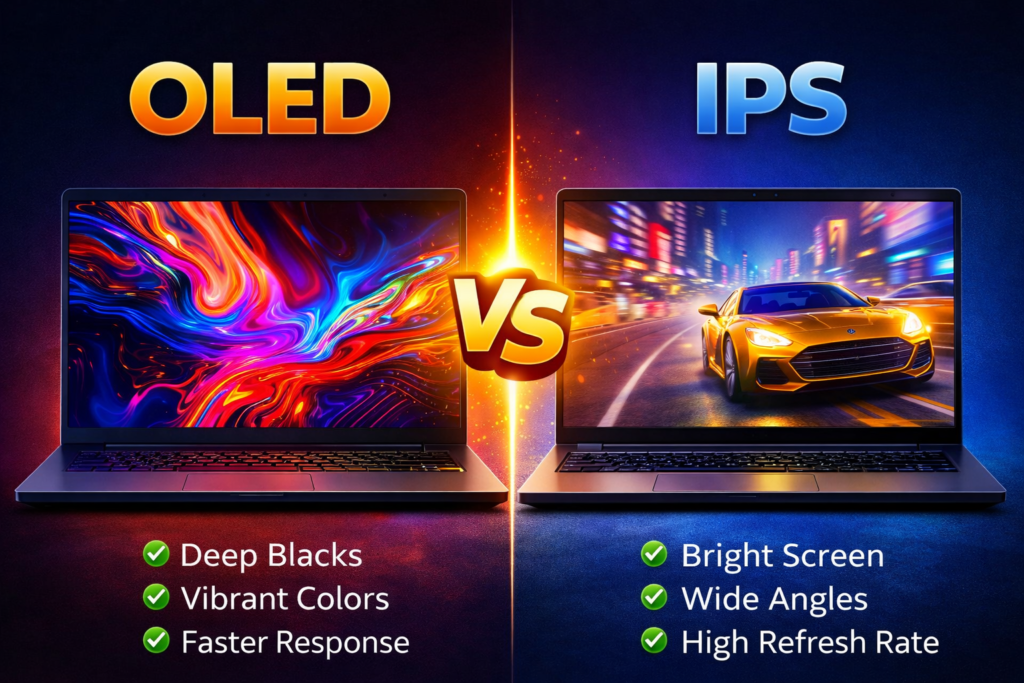
- OLED (Organic Light Emitting Diode) displays use self-emitting pixels. Each pixel creates its own light.
- IPS (In-Plane Switching) displays use a backlight behind the panel to illuminate the screen.
Because OLED pixels light themselves, they can turn completely off, producing true blacks and infinite contrast. IPS displays rely on a backlight, which means blacks appear slightly gray.
Both technologies are excellent, but they are designed for different types of users.
OLED vs IPS Comparison Table
| Feature | OLED Display | IPS Display |
|---|---|---|
| Display Technology | Self-emitting pixels (no backlight) | Uses LED backlight behind the panel |
| Black Levels | Perfect blacks (pixels turn off completely) | Blacks appear slightly gray |
| Contrast Ratio | Extremely high (almost infinite) | Good but lower than OLED |
| Color Quality | Very vibrant and rich colors | Accurate but slightly less vibrant |
| Brightness | Good brightness but varies by model | Usually brighter in many laptops |
| Response Time | Extremely fast (almost instant) | Slower than OLED but still good |
| Viewing Angles | Excellent viewing angles | Excellent viewing angles |
| Gaming Experience | Great visuals and fast response | Often supports higher refresh rates |
| Burn-in Risk | Possible but rare with modern panels | No burn-in issues |
| Power Consumption | Lower with dark content | Consistent power usage |
| Price | Usually more expensive | More affordable |
| Best For | Movies, creative work, premium laptops | Gaming, everyday use, budget laptops |
Design and Build Quality in OLED vs IPS Laptops
Modern laptops with both display technologies usually have premium designs.
However, OLED laptops often appear in thin and premium models because the display panel itself is thinner.
Typical design features include:
- Ultra-thin bezels
- Lightweight aluminum chassis
- Slim laptop profiles
- Premium keyboard and trackpad
Many OLED vs IPS laptop comparisons show that OLED models are commonly used in premium ultrabooks and creator laptops, while IPS displays are widely used across budget and mid-range laptops.
Display Quality: OLED vs IPS
Display quality is where the biggest difference appears in the OLED vs IPS comparison.
OLED Display Features
OLED panels are known for exceptional picture quality.
Key advantages include:
- True black levels
- Infinite contrast ratio
- Extremely vibrant colors
- Faster pixel response times
- Excellent HDR performance
These qualities make OLED displays ideal for:
- Watching movies
- Content creation
- Photo and video editing
- Premium gaming laptops
IPS Display Features
IPS displays are still extremely popular because they provide balanced performance.
Key advantages include:
- Good color accuracy
- Bright screens
- Wide viewing angles
- Lower cost compared to OLED
In the OLED vs IPS comparison, IPS displays are often used in budget and gaming laptops because they offer reliable performance at a lower price.
Performance in OLED vs IPS Displays
In general laptop usage, both OLED and IPS displays perform very well.
However, some differences appear when we compare them closely.
OLED Performance
- Instant pixel response time
- Higher contrast ratio
- Better HDR support
IPS Performance
- Higher sustained brightness
- No burn-in risk
- Longer lifespan in some cases
When discussing OLED vs IPS, OLED delivers better visual quality, while IPS offers more long-term reliability for heavy daily use.
Gaming Experience: OLED vs IPS
For gamers, the OLED vs IPS comparison becomes very interesting.
Gaming on OLED Displays
OLED screens provide:
- Extremely fast response times
- Deep blacks and strong contrast
- Beautiful HDR gaming visuals
These features create an immersive gaming experience, especially in story-driven games.
Gaming on IPS Displays
IPS gaming laptops often feature:
- High refresh rates (120Hz, 144Hz, or 165Hz)
- Smooth motion during gameplay
- Lower cost
For competitive gaming, IPS displays are still widely used because many models support high refresh rates.
Cooling Considerations
Cooling is usually related to the laptop’s internal hardware rather than the display type. However, OLED displays consume less power when showing dark content.
This means laptops with OLED panels may sometimes generate slightly less heat during certain tasks.
In the OLED vs IPS comparison, cooling differences are generally minimal and depend more on the laptop’s processor and GPU.
Battery Life: OLED vs IPS
Battery life can vary depending on screen technology.
OLED Battery Behavior
OLED screens can save power when displaying dark colors because individual pixels turn off completely.
However, bright content may consume more power.
IPS Battery Behavior
IPS displays have a constant backlight, so power consumption remains more consistent.
In many real-world scenarios, the OLED vs IPS battery difference depends heavily on how you use the laptop.
Popular OLED vs IPS Laptop Examples
Here are some laptops that use these display technologies.
ASUS Vivobook Go 15 OLED
Specifications:
- Processor: AMD Ryzen 5 7520U
- Display: 15.6-inch OLED Full HD
- RAM: 16GB
- Storage: 512GB SSD
- Battery: Up to 8 hours
This laptop is a good example of how OLED displays deliver vibrant colors and excellent media experience.
Dell XPS 13 OLED
Specifications:
- Processor: Intel Core i7
- Display: 13.4-inch OLED 3.5K
- RAM: 16GB
- Storage: 512GB SSD
- Battery: Up to 10 hours
The Dell XPS series is known for premium OLED displays and excellent build quality.
Acer Aspire 7 (IPS Display)
Specifications:
- Processor: AMD Ryzen 5 5500U
- GPU: NVIDIA GTX 1650
- Display: 15.6-inch Full HD IPS
- RAM: 8GB
- Storage: 512GB SSD
This laptop shows how IPS panels are widely used in affordable gaming laptops.
Lenovo IdeaPad Gaming 3 (IPS)
Specifications:
- Processor: AMD Ryzen 5 5600H
- GPU: NVIDIA RTX 3050
- Display: 15.6-inch Full HD IPS 120Hz
- RAM: 16GB
- Storage: 512GB SSD
IPS displays remain popular in gaming laptops because of high refresh rates.
Pros and Cons of OLED vs IPS
OLED Pros
- Perfect black levels
- Incredible contrast
- Excellent HDR quality
- Faster pixel response
OLED Cons
- Higher cost
- Potential burn-in risk (rare with modern panels)
- Lower maximum brightness in some models
IPS Pros
- More affordable
- Bright screens
- High refresh rate options
- No burn-in risk
IPS Cons
- Lower contrast ratio
- Blacks may look gray
- Colors slightly less vibrant than OLED
Final Verdict: OLED vs IPS
The OLED vs IPS debate ultimately depends on what you value most in a laptop display.
If you want the best visual quality, deep blacks, and stunning colors, OLED displays are the clear winner. They are perfect for movies, creative work, and immersive gaming.
However, if you prefer a more affordable laptop with reliable performance and high refresh rates, IPS displays remain a fantastic choice.
Both technologies have their strengths, and neither is universally better for every user. The best option depends on your budget, usage, and personal preference.
For many users, choosing between OLED vs IPS simply comes down to whether you prioritize visual quality or overall practicality.
FAQ – OLED vs IPS
1. Which is better: OLED or IPS?
In the OLED vs IPS comparison, OLED offers better contrast, deeper blacks, and more vibrant colors. IPS displays are usually brighter, more affordable, and widely used in gaming laptops with high refresh rates.
2. Is OLED better than IPS for gaming?
OLED displays provide faster response times and better contrast, which improves visual quality in games. However, IPS gaming monitors often support higher refresh rates, making them popular for competitive gaming.
3. Does OLED have better picture quality than IPS?
Yes, OLED generally has better picture quality than IPS. In the OLED vs IPS comparison, OLED displays deliver deeper blacks, higher contrast ratios, and richer colors because each pixel produces its own light.
4. Is IPS display good for laptops?
Yes, IPS displays are widely used in laptops because they provide good color accuracy, wide viewing angles, and reliable performance. Many budget and mid-range laptops use IPS panels.
5. Which display lasts longer: OLED or IPS?
IPS displays generally have a longer lifespan because they use a traditional backlight system. OLED screens can degrade over time, but modern OLED panels are designed to last many years.